
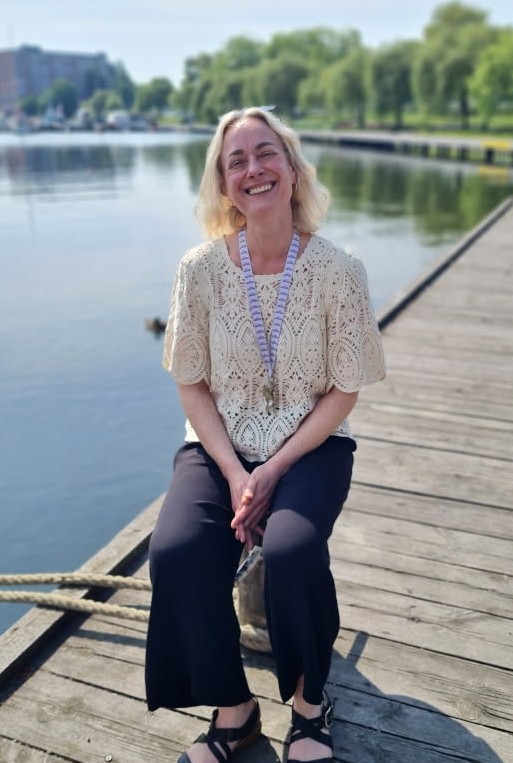
Venus is a social worker by training and has extensive experience of working with people who have needed support in various ways or have fallen between the cracks.
Today she works in Alis-Lumena, where she supports young adults to get closer to work and studies.
She is also very committed to issues of empowerment and participatory inclusion.
Can you tell us a bit about yourself and your background?
I have a lot of experience, and that's a big part of why I get involved in what I do. It's a big part of my commitment.
I have ten years of experience with mental illness where I have not been able to work or study. I started studying quite late and my way back from a recovery perspective was through education on a two-year vocational training programme.
After that, I started working with people with addiction problems in a residential centre. During that period I was pretty sure that I wanted to further my education and have been thinking about studying social work.
After a couple of years, when I had recovered enough and gained some distance, I started studying to become a social worker. It was after that that I started working in children and youth as a social worker. After that I applied for the Alis project.
The Alis project was an existing project before Lumena started. It started in 2018 but on a much smaller scale. We were targeting young adults aged 18-29. Over the years it has grown and developed further. Alis was then partly funded by the coordination association in Södertälje.
When Lumena started, we wanted to develop to include people over the age of 29, which we saw a great need for, and with the regional Lumena project, Alis became part of it. Now in Södertälje we have two ”branches” of Lumena: Alis for those aged 18-29 and Lumena 30+ for the older target group. But both projects work with the same methods and the same approach with a job counsellor and a mentor.
What is your role in the Lumena project now?
I think we are the only project where we have split roles. We work as a team with a job counsellor who provides IPS support and a mentor who works as a CM/coordinator with each participant. This means that the job counsellor focuses on work and study and the mentor coordinates the support needed around that.
The role involves a lot of dialogue, coordination and sounding board where I help in contact with various authorities
I have been working as a mentor since the beginning and have been in this role for four years. It is my role to work on supporting and removing obstacles to work and study. The role involves a lot of dialogue, coordination and sounding board where I help in contact with various authorities.
I also provide support in empowerment, to be a kind of sounding board in participating as a fellow human being and to be a companion. I also help with providing information, being a bridge between different authorities and promoting power equalisation.
For me, empowerment is about the individual's need for self-determination and basically to be able to influence their own life
How would you describe empowerment?
For me, empowerment is about the individual's need for self-determination and basically being able to influence their own lives. To be an expert in one's own life and to be able to make one's voice heard in the ways that the person can and wants. To be able to formulate their own thoughts, feelings, wishes and needs and not to be objectified by others. In other words, to get away from others making judgements about you. To be able to own your own story and then use it to shape support around what is important and desirable. I also think that it is a process, not something fixed. Finding confidence in your own ability (in interaction and together with someone else) because it is often a basis for being more active and making your own choices. Without having access to your own voice, it is difficult to make it heard in other contexts with and to others.
Do you feel that many people have not had this opportunity before?
Many express that there has been no interest or curiosity to listen. Many of the people we meet have school or parents as their frame of reference. Much of the framework has already been laid down and the participants try to relate to what has already been decided. In the project, we have an opportunity to create a space where we have no expectations.
The path to work and study is much more open to create the right conditions. In the project, we explore the way there together.
What do you consider to be the advantages of working in project mode?
There is a completely different freedom that we have noticed is needed, we can adapt more individually. We don't have a special target group either, except that we have an age range. Nor do we work on behalf of any other authority.
What do you think are the most common reasons for falling through the cracks?
If you have a complex situation, I feel that there is no one who wants a holistic perspective and that this creates a lack of collaboration.
The holistic perspective and difficulties in co-operation are linked. It is perhaps not the collaboration itself that is difficult, but the lack of a holistic perspective and individualisation. A person has to fit into a template, there is a hierarchy, especially in the diagnostic system.
What do you think is most important about participant inclusion?
It's the whole framework of it being the participant's own story, that they get to make their voice heard and that they get to talk about what's important to them. I've seen the power of that process, of putting together a story and having the opportunity to influence society and decision-makers with your own story. There is a power in that.
It's the whole framing of it being the participant's own story, that they get to make their voice heard and that they get to talk about what is important to them
How have you been able to motivate participants to share their journey?
That there is someone who thinks it is important and encourages them to share. It sends a signal that their experiences are important and matter. It doesn't always look like that, some participants have been at home for five or six years, in some cases eight, and have been isolated. Some are passionate about telling it and sharing it with someone that no one asked for before. Many also feel a strong sense of anger and frustration at how society and the adult world have let them down.
Of course, I would ideally like to see more participant inclusion after the end of the project and a focus on empowerment in all existing activities
What would you like participant inclusion to look like at the end of the project?
Of course, I would like to see more participant inclusion after the end of the project and a focus on empowerment in all existing activities. In the same way that I wish that our methods and approaches would be given more space and conditions within different organisations. That it should not be dependent on a project like Lumena driving it as a single issue, activity or goal.
Both research and the project's results have shown that it is important for the individual and effective in achieving work and study. For the participants who have been involved in the project, I hope that it has led to them wanting to continue to get involved either in some organised form or just for themselves, in their own life and everyday life.
Read the stories of our participants: Participant stories - LumenaConecto and also watch our participant film ✨
 EN
EN  SV
SV  FI
FI  ES
ES  AR
AR  TR
TR